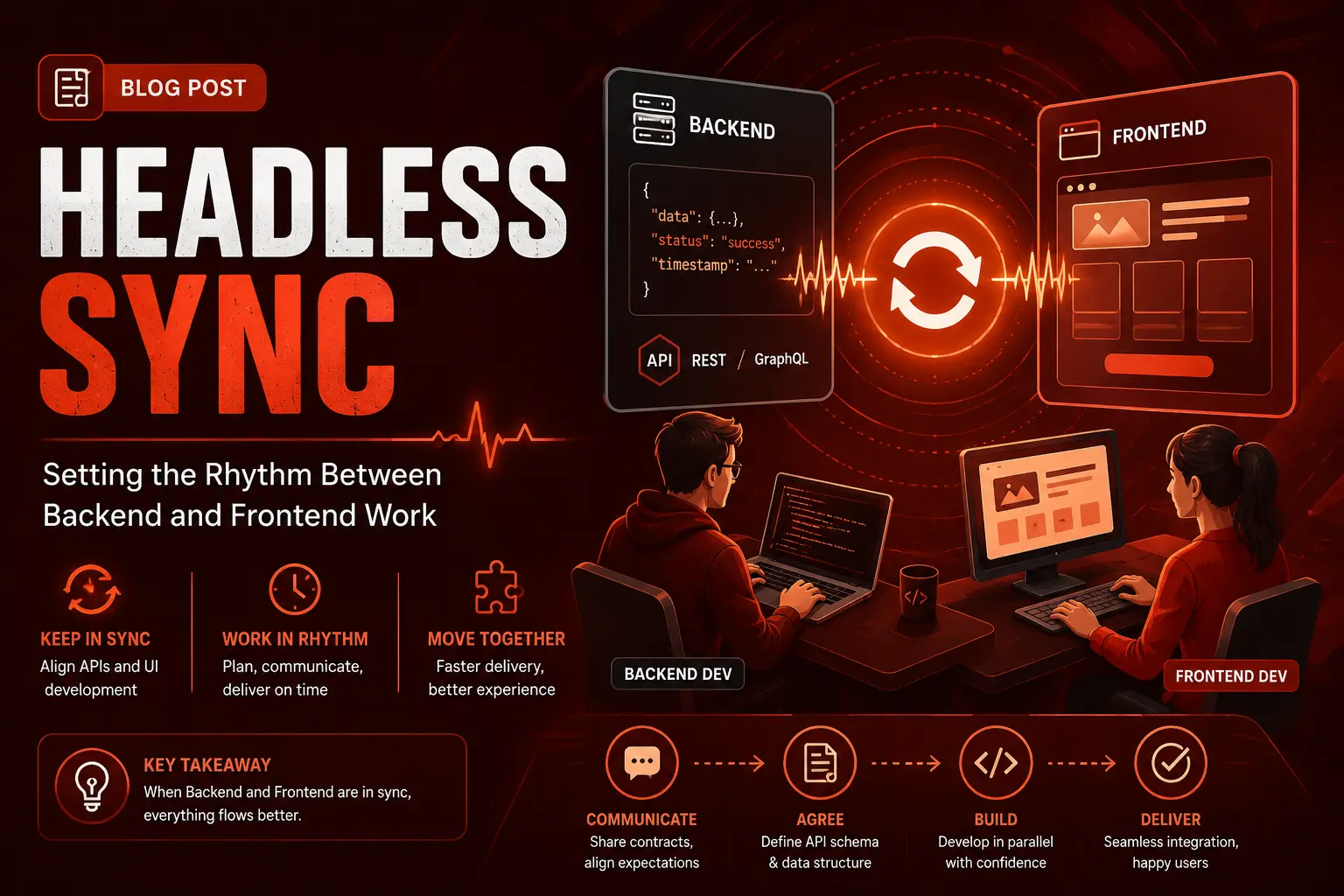
Moving to a headless (decoupled) architecture is often a double-edged sword. On one hand, flexibility increases drastically. On the other, the risk of desynchronization between Backend (BE) and Frontend (FE) becomes a daily challenge.
A classic problem many teams encounter: the FE team is blocked waiting for API endpoints to be finished, or the BE team changes the response structure without notice. This is an inefficiency that must be eliminated.
The Foundation: Wireframes and Blueprinting
Before diving into high-fidelity UI/UX designs or writing a single line of backend code, the synchronization workflow must begin with structural clarity.
- Wireframing First: We map out user journeys through low-fidelity wireframes. This establishes the layout, user flows, and—most importantly—the data required on each screen before the UI/UX team refines the aesthetics.
- Data Requirements Mapping: By looking at the wireframe, we can immediately identify what data points need to be fetched or sent.
API Contract: Bridging the Gap Early
Instead of waiting for the backend logic to be fully coded, we establish an API-first approach using tools that maximize transparency and accessibility:
- The Spreadsheet Draft: We utilize spreadsheets as a highly collaborative, easy-to-read scratchpad to list out the required REST API endpoints, query parameters, and payload structures.
- The GitLab Issue Contract: Once the spreadsheet layout is agreed upon, the finalized API contract is documented directly inside the detailed technical description of a GitLab Issue. This serves as the immutable "Single Source of Truth." With this clear contract, the FE team can start building UI components using mock data without being blocked by BE progress.
Git-Integrated API Development & SA Guardrails
To ensure the code matches the business requirements, the implementation phase follows a strict verification loop:
- Bruno for API Collection: The BE team develops and tests their REST APIs using Bruno. Because Bruno saves collections as plain text files directly within the project repository, the API collection scales and versions alongside the source code.
- System Analyst Verification: As a System Analyst, this repository-integrated approach allows me to easily pull the Bruno collections, test the live responses, and verify that the API endpoints, error handling, and data structures align perfectly with the core business logic before final integration.
Task Management & Parallelization
To maintain speed, tasks on the Kanban board are decoupled:
- Parallel Task Decomposition: Do not make FE tasks strictly dependent on BE completion. Split FE tasks into UI component development using static fixtures based on the agreed GitLab contract.
- Centralized Backend Validation: Avoid duplicating validation rules on both sides. Establish the principle that the backend is the sole gatekeeper of data validity. The FE team focuses on catching error responses (like HTTP Status 422) and rendering those messages dynamically, cutting development time significantly.
The success of headless development lies not in how sophisticated your tech stack is, but in how robust your workflow pipeline is. By connecting wireframes, GitLab contracts, and git-integrated API testing with Bruno, the gap between backend logic and frontend presentation is seamlessly bridged.