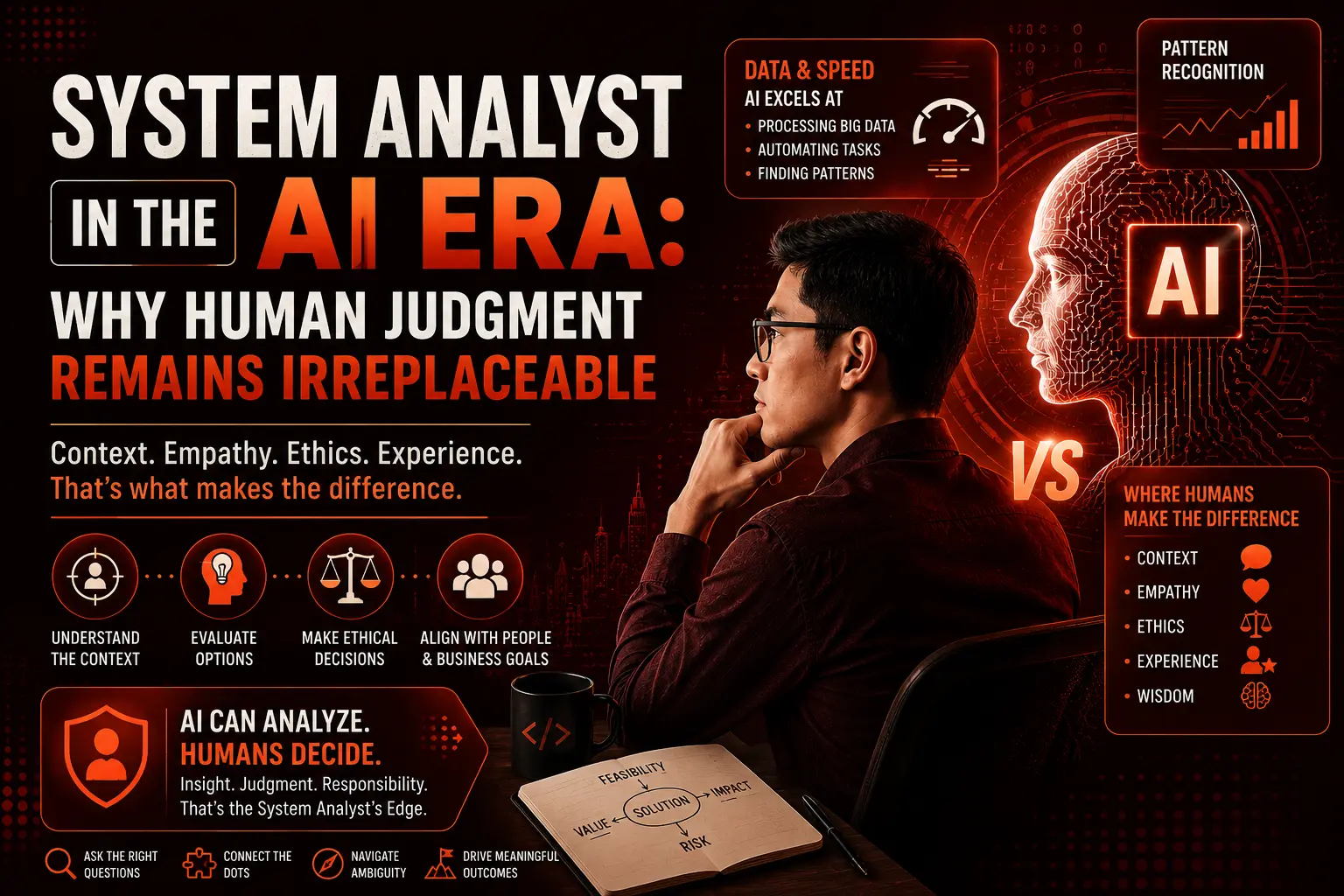
Amidst the loud narrative that AI will replace various IT roles, I see the exact opposite happening for System Analysts (SAs). The presence of AI actually makes the SA role far more powerful, transformative, and strategic in tackling the complexities of modern tech architecture.
AI is not a threat; it is the ultimate assistant. By leveraging LLM-based tools, an SA now possesses superpowers to design intricate features and complex logic, map out hundreds of easily missed edge-case scenarios, and draft comprehensive requirement documents in minutes.
AI Handles Code, Humans Handle Humans
Why then, can AI not replace a System Analyst? The answer is simple: an SA's job has never been just about writing technical specifications or understanding code. The core of this role is communication, empathy, and negotiation with clients or stakeholders.
AI can generate thousands of lines of documentation, but it cannot read a client's hesitant body language during project scoping. AI lacks the intuition to balance a client's business idealism with tight budget constraints and timelines. The ultimate decision-making (judgment) and validation of real-world human problems still absolutely require human awareness.
A Significant Shift in the Modern Era
In today's tech landscape, AI brings a tremendous efficiency shift to our daily workflow:
- Faster: The initial drafting process for system architecture and functionality can be cut down by up to 70%.
- More Accurate: AI helps spot logic security loopholes or data flow inconsistencies right from the design phase.
- More Productive & Impactful: Time previously spent on repetitive documentation tasks can now be allocated to thinking about product strategy innovation and high-level architecture.
Ultimately, AI will not replace System Analysts. However, System Analysts who utilize AI will undoubtedly replace those who do not.